
Adapted from the July 2026 issue of my newsletter. Sign up to get the next one by email.
Late July heat is still sitting on much of the country, and for people living outside it remains one of the most immediate dangers on the calendar. What may have changed is what is on your desk: the FY2026 Continuum of Care Program competition is due August 26, following one of the most consequential rewrites of the competition rules in more than a decade, and most of the field is spending this exact month buried in it.
So this post is different. No essay, no argument about the count. This is about four problems this field keeps running into, and four free tools and resources I am building to help. All of them are still being improved, and that is deliberate: before communities rely on them more broadly, I need the field to pressure-test them. This post is the invitation.
First, a word about who “you” is. Some of you manage CoCs and HMIS implementations. Many of you are board members, funders, elected officials, researchers, or people who simply care how your community responds to homelessness. This is written for both groups. Each tool gets a plain one-sentence version first, then the detail. If the detail is not for you, sending this to your CoC director, HMIS lead, or data team may be the most useful thing you do with this page.
The four problems, and the four tools, in one sentence each:
- Communities do not have enough housing for everyone who needs it, so they must decide who is offered assistance first, often using a numeric assessment that participants and decision-makers struggle to interpret. HEAT makes that assessment explain itself.
- Communities can lose competition points to data problems they discover only after it is too late to fix them. SysPM finds those problems while they can still be corrected.
- Every fall, communities spend weeks in an upload-error-fix cycle on a massive required data submission. LSA surfaces the errors before the deadline pressure starts.
- The $4.04 billion federal funding application due August 26 runs on a dense rulebook with 52 scored criteria. The free NOFO prep package is the study guide and scoring workbook for it.
A note on how these were built, once, and then I will leave it alone. These tools use modern software development techniques, including AI where appropriate. AI accelerated the coding and documentation; the rules, formulas, citations, and determinations were reviewed against HUD source material and tested before publication.
But there is one layer of vetting I cannot do alone, and that is the point of this post.
Today’s claim, in one sentence: a tool that touches how your system assesses people or reports performance should show its work.
This month, I am asking you to check mine.
Every tool below is free, with no accounts and no logins. The applications are not designed to retain uploaded client-level data. Each tool, along with the NOFO package page, has a feedback button, and every note that comes through is read by a human: me. When something looks off, flag it.
HEAT: making coordinated entry assessment explain itself
Start with the problem, because it is one everyone can understand. Every community faces the same impossible reality: there are more people who need housing than there is housing available. That means prioritization is unavoidable. The question is not whether prioritization happens. The question is whether it happens transparently, consistently, and in a way that everyone involved can understand. The field’s name for this process is coordinated entry, and for much of the past decade, many communities have relied heavily on numeric vulnerability assessments to run it.
The failure mode is familiar to anyone who has sat in a case conference. A score of 9 walks in ahead of a score of 8, nobody in the room can say exactly why, and the participant cannot be told what the number means. Communities have been moving away from that model for years. The open question has been what replaces it.
HEAT, the Housing Emergency Access Tool at heat.gaitherdyn.com, is my answer: not a better score, but no score at all. To be precise about its role: HEAT does not decide who receives housing. It is decision support that organizes reported information and applies published rules transparently; your CoC’s written policy decides priority. It is built on one design rule: every determination explains itself. An explanation a participant can understand, a case manager can act on, a supervisor can audit, and a reviewer can independently reconstruct. The same answers always produce the same determinations under the same published rules. Instead of a number, an assessment ends in four outputs:
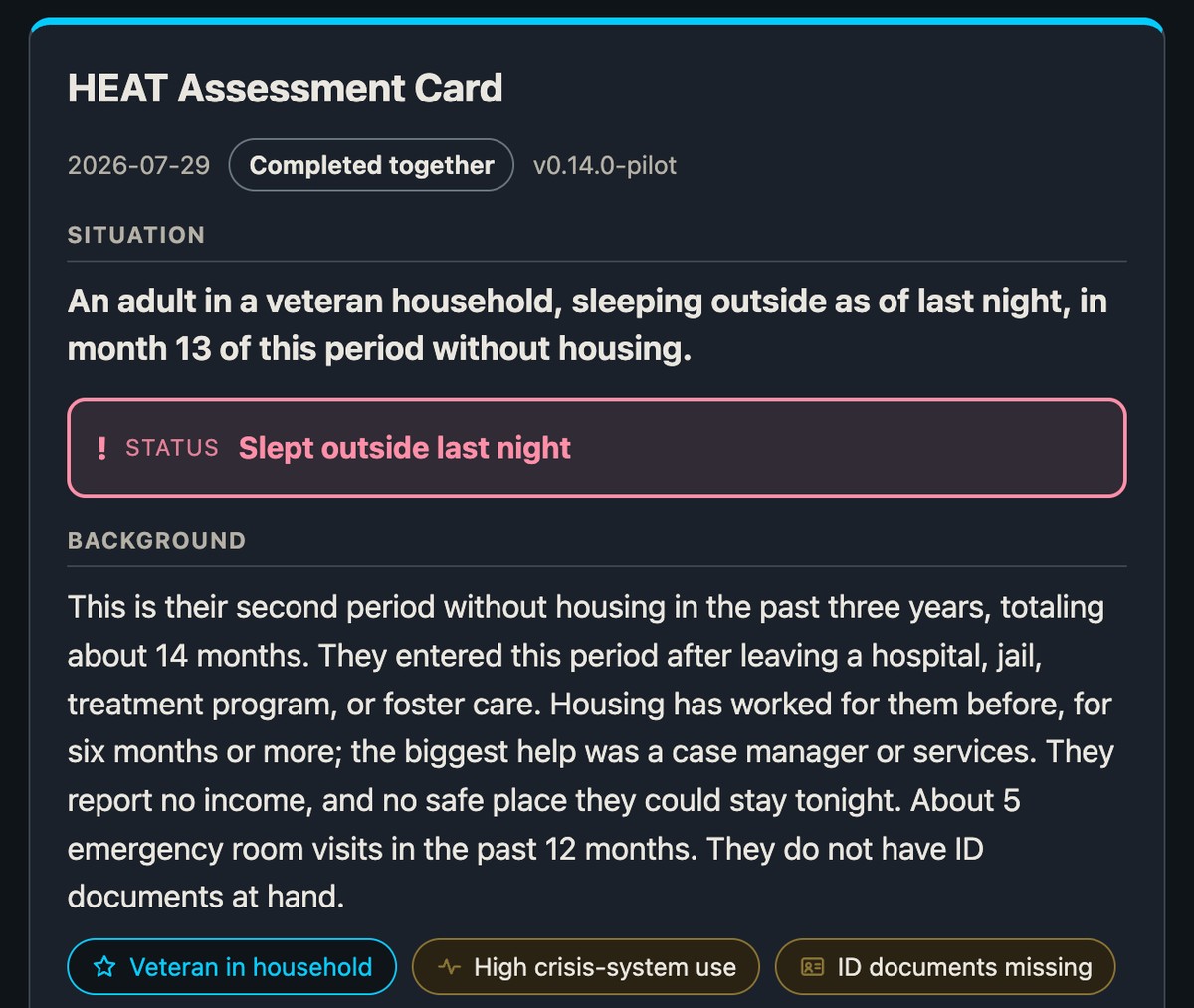
- Immediate action. A neutral safety screen that routes emergencies to live help first. Workflow only, never allocation.
- Chronicity, computed. An evaluation of whether the reported circumstances appear to meet HUD’s chronic homelessness definition under 24 CFR 578.3, with the time calculations shown and a checklist of the documentation still needed. The rules are encoded from the Federal Register and the HMIS Data Standards, with the rules document cited on the result.
- Support planning level. A categorical read on the type and intensity of support worth discussing, not a priority score. Missing or declined answers are reported as missing, never counted against anyone.
- Intervention discussion. Options to discuss, each with reasons, open eligibility questions, and cautions. Decision support, never automated placement.
Each conclusion comes from published rules or documented decision logic a person can read, backed by an automated test suite. No numeric priority scores exist anywhere in it; priority policy stays in your CoC’s written standards. In public mode, assessment answers are processed on your device rather than sent to a server, and nothing about you is saved unless you choose to save or share a result.
HEAT is in public beta and not for production decision making yet. What I need now is exactly what you have: field eyes. Two ways to give them, in increasing order of commitment:
Try it in five minutes. Go look at a sample result with no questions asked, or run the assessment preview yourself. Each question, its purpose and supporting basis, the governance model, and the full changelog, mistakes included, are public on the site.
Pilot it before replacing your current assessment. To be clear about where this goes: nobody wants to run two assessments forever, and that is not the plan. HEAT is built to become your assessment, not to sit beside one. The shadow pilot is the bridge. For a limited window, HEAT runs after your current tool, asks about 25 questions for most people, and affects no referrals, so your case conferences can compare the two outputs side by side using your own data. If HEAT earns it, it replaces your current tool through your CoC’s written-standards process. If it does not, you walk away having lost nothing, and the comparison data is yours to keep. If that interests you, schedule a virtual meeting.
The ask for HEAT: challenge all of it. There is a standing challenge, open to everyone: find a scenario where you believe HEAT reaches the wrong determination. Send it through the flag button, with your name or handle if you want credit. Each accepted case joins the permanent regression suite before any fix is written. And do not stop at the determinations. Vet the questions themselves: the wording, what gets asked, what should not be asked at all, and the stated basis for each one on the questions page. Your skepticism literally becomes part of the product.
SysPM: find the data problems before they affect your score
Communities can lose competition points to data problems they discover only after the numbers are already submitted. HUD’s System Performance Measures are calculated from HMIS data and function as a federal scorecard for each community. The FY2026 rubric leans heavily on fields many HMIS implementations were never designed to capture cleanly: earned income, subsidized versus unsubsidized exits, and returns to homelessness. The practical obstacle has always been access: during the busiest month of the year, seeing your own numbers usually means waiting in a vendor report queue.
I built syspm.gaitherdyn.com to remove that wait. Upload a hashed HUD CSV export (a .zip, up to 1 GB), pick your report period, and the engine computes System Performance Measures 1 through 7, the data quality reports, and a diagnostic score and grade, in one pass. The grade is my construct for prioritizing cleanup work, not an official HUD rating.
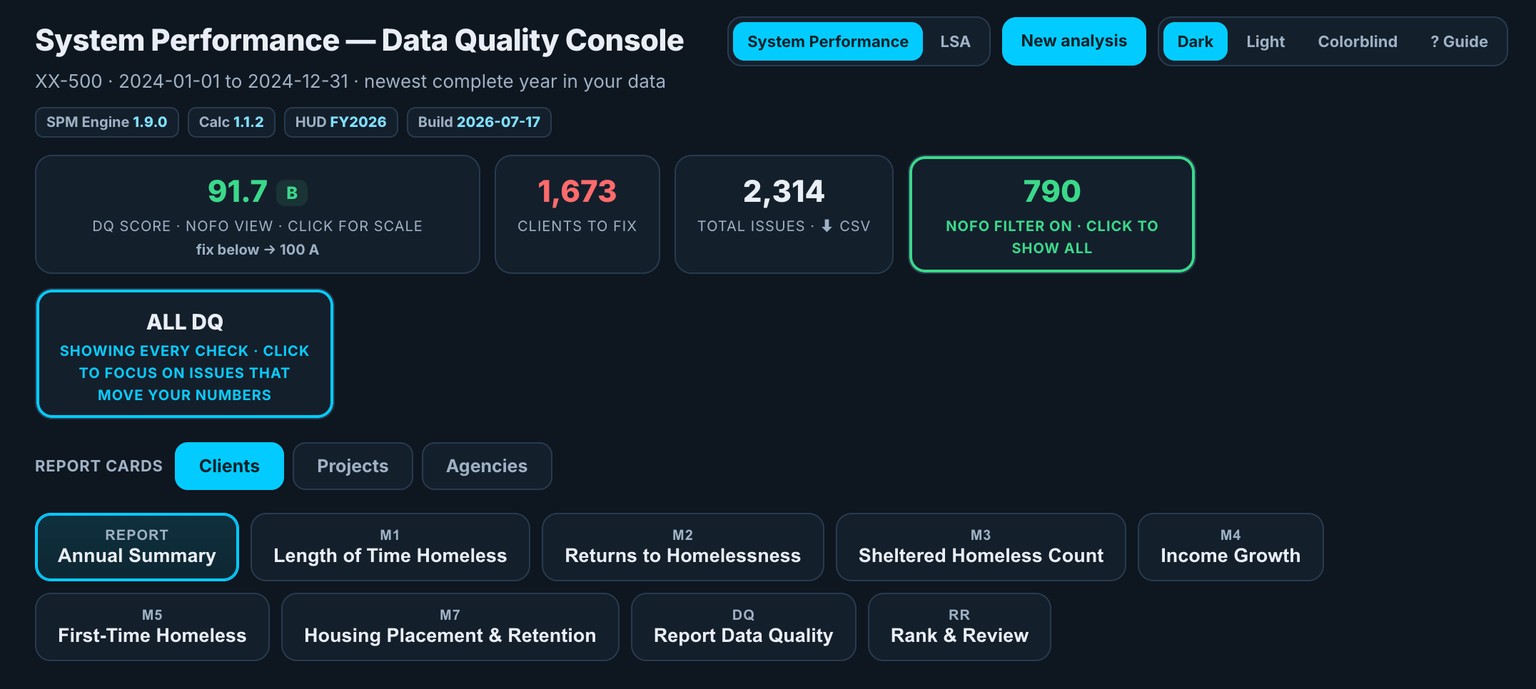
Then it connects the cleanup to the competition. Issues are ranked by how much each one hurts the measure, and a NOFO-impacting filter narrows the console to the problems that touch numbers the FY2026 competition scores. A Rank & Review report computes live project and agency scorecards, housing exits, returns, income growth and the rest, the kinds of performance metrics many CoCs fold into local Rank and Review processes and Priority Listing decisions. No correction guarantees a point, but the line from record to measure to rubric is visible. Fix clients in your HMIS, check them off in the console, and watch the grades respond.
On privacy: the tool accepts hashed HUD CSV exports rather than identifiable ones, so direct identifiers like names and Social Security numbers should not be in the file at all. Uploads are processed for the analysis and then discarded; there are no accounts and no saved copies. Your CoC’s privacy and data-sharing policies still apply, so follow them.
No data handy, or want to see it before asking your HMIS lead for an export? Load one of the three fully synthetic demo CoCs, small, medium, or large, straight from the front page.
The ask for SysPM: find a calculation I got wrong. The tool is provided as-is, so confirm results against your vendor’s official reports before acting on them. If your vendor’s report and this engine disagree on a measure, there is a calculation, configuration, or interpretation difference worth investigating. Either way, it is worth a flag.
LSA: the same engine, pointed at your fall submission
The Longitudinal Systems Analysis is the other data gauntlet on the calendar. In plain terms, the LSA is HUD’s annual system-level account of who entered homelessness, how they moved through the response system, and where they exited. Beginning each fall, HMIS leads submit it through HDX 2.0 and often spend weeks in an upload-error-fix cycle while the deadline gets closer. The errors were sitting in the data all along. The only thing missing was a way to see them early.
That early look now exists at lsa.gaitherdyn.com. Upload a hashed HUD CSV export and get an LSA-focused data quality console on the spot: client, project, and agency report cards, plus the same NOFO-impacting filter as SysPM. This is a pre-submission check, not a replacement for the official LSA process. Uploads are processed for the analysis and then discarded, with no accounts and no saved copies. A synthetic demo is available if you just want to look around first.
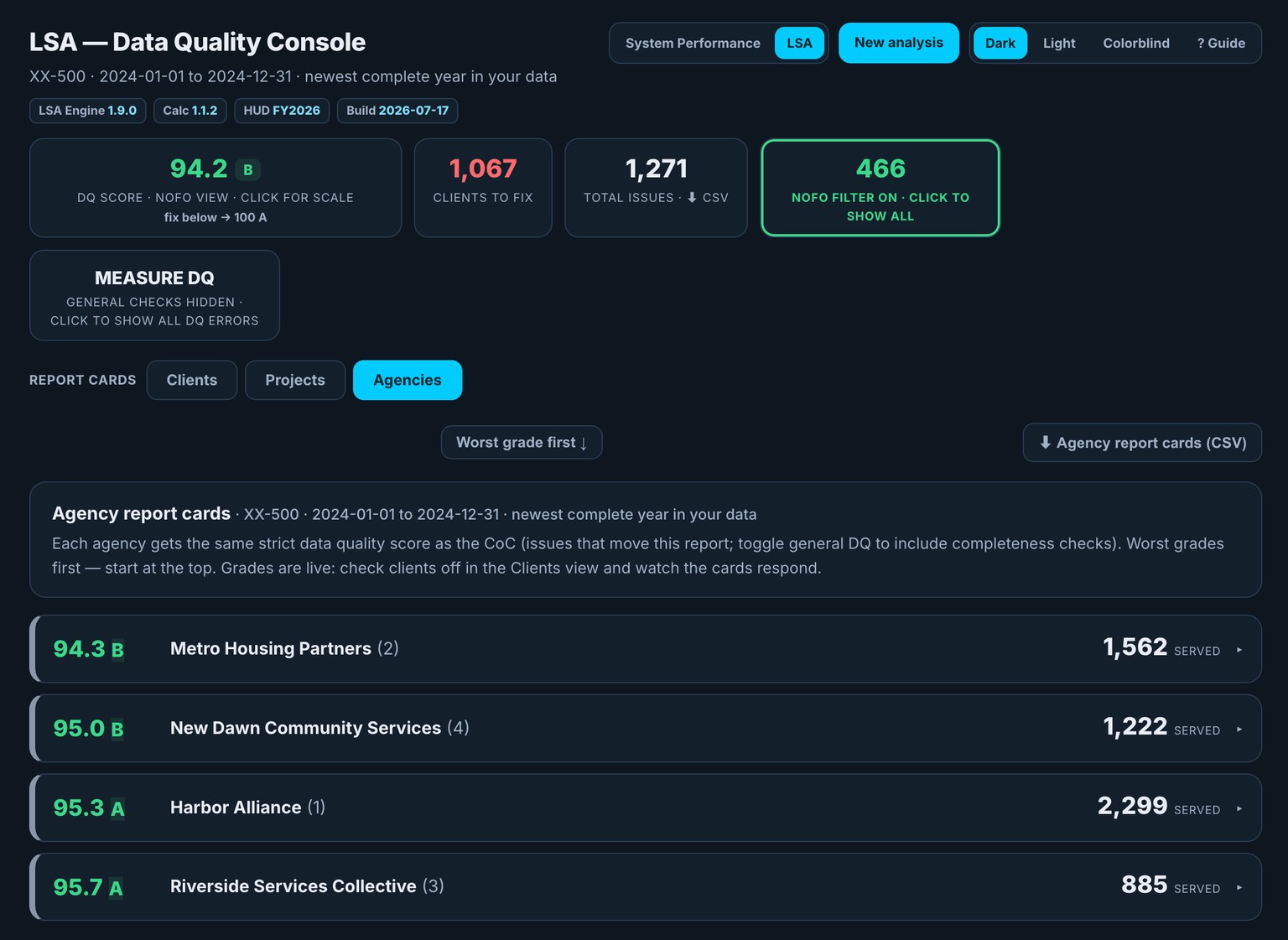
The ask for LSA: compare its findings with HDX. If the validation and warning messages returned through HDX 2.0 contradict the console, or catch something it missed, flag it. That one flag may save the next CoC the same surprise.
Three weeks out: the free FY2026 NOFO prep package
If you are in the middle of the application right now, this one is immediate. The free FY2026 CoC NOFO prep package is a 21-page guide plus a 12-tab scoring workbook covering all 52 scored criteria in the $4.04 billion competition, including the Tier 2 ranking math.

It is on version 1.5, updated July 29. Each point value, category sum, page citation, and formula was audited line by line against the NOFO PDF. The July updates also track a competition that keeps moving: the June 29 ruling that struck down HUD’s FY2025 rules, the July 2 legal challenge to the FY2026 NOFO itself, HUD’s July 16 notice that it intends to modify the NOFO, and the e-snaps materials released July 21. The package also folds in HUD’s own FAQ clarifications communities keep asking about: the transitional housing engagement hours are flexible, and the drug-free certification is not a sobriety mandate (both on page 6 of the June FAQ), so you can verify the source yourself.
Two practical notes. First, for planning purposes use August 26 at 8:00 PM Eastern: HUD’s webpage and the NOFO cover now both state that time, although one interior page still prints a later one. Submit early. Second, the workbook does the Tier 2 ranking arithmetic for you, which matters more this year than it ever has: only 60 percent of a CoC’s renewal demand falls within Tier 1, the portion more protected from national competition, leaving a much larger share of existing grants dependent on project score and national selection.
I will be candid: of the four, this is the item most exposed to interpretation. The numbers are audited, but the NOFO leaves real questions open; HUD’s own FAQ still does not answer how bonus points interact with the Tier 2 ranking formula. So the ask here is different: if you find a mistake, missing guidance, or a better interpretation than mine, email me directly. I would rather improve it now than have someone discover an error the week applications are due.
Closing
Here is the method behind everything in this post, stated plainly. Modern tools have collapsed the cost of building software for this field. That is an opportunity and a hazard at the same time, because speed without vetting just produces wrong answers faster. The discipline that makes the speed safe is old-fashioned: encode the actual regulation, cite the actual page number, publish the mistakes, and put a flag button on every page.
That last step is where you come in. Better software does not come from programming alone. It comes from practitioners who are willing to say, “this does not look right.” Technical testing can prove that software follows its rules. Only practitioners can tell me whether those rules reflect reality. That is what I am asking for this month. Each flag, each mismatched number, each scenario sent to HEAT’s standing challenge makes these tools more trustworthy for the next community that loads them. The tools are free because communities need them. The vetting is shared because meaningful validation cannot happen inside one company.
Use them. Break them. Tell me where they are wrong.
And if this post was not written for you, it was written for someone you know. Share it.

Reach me on LinkedIn, schedule a meeting, or email me at Gaither.Stephens@GaitherDyn.com. Send your colleagues to GaitherDyn.com/sign-up.
PS: more to explore, and where I’ll be
A few more things I have built that you are welcome to poke at. The CoC Funding Explorer puts every CoC Program award dollar from public HUD data in one place, FY2012 through FY2024: national trends, per-CoC benchmarks, agency-level grants, and a modeled family-funding lens, with the full methodology on the page. The National Homeless Performance Dashboard provides public CoC benchmarking from HUD data, 2015 through 2024. And the CoC Alliance gives communities a place to share what works outside the competition.
NHSDC Fall 2026, Cleveland. I will be exhibiting at the Fall National Human Services Data Consortium conference this October. Come find the booth; this post’s tools will all be there to demo live.
Kansas Statewide Homeless Coalition keynote. Confirmed to deliver the keynote at KSHC’s Summit on Homelessness and Housing, April 20-21, 2027, at the DoubleTree by Hilton in Overland Park, Kansas. Details at kshomeless.com/kshc/summit.